
Milan Through Hemingway’s Eyes, The City That Forges Writers
When Ernest Hemingway arrived in Milan in 1918, he was not yet the literary giant the world would come to know. He was a 19-year-old American volunteer with the Red Cross, sent to the Italian front during the First World War. Yet it was Milan — with its austere elegance, its contradictions, its direct humanity — that would etch itself deeply into Hemingway’s imagination.
A Wounded City, Much Like Him
Hemingway reached Milan shortly after being injured on the Piave front. The city at that time was suspended, convalescent, much like the soldiers who filled its hospitals. In the rational buildings and wide streets, Hemingway sensed the breath of a modern but vulnerable city.
He was admitted to the Red Cross hospital at Via Alessandro Manzoni 10, an elegant building that would become a symbolic shrine in his personal mythology. It was there that he met nurse Agnes von Kurowsky, the woman who inspired Catherine Barkley in A Farewell to Arms. But more than anything, it was Milan that penetrated his writing: the persistent rain, the light filtering through the porticoes, the trams cutting through the fog.
The Modern Heart of Italy
To the young American, Milan was already the most European of Italian cities. The Galleria Vittorio Emanuele II appeared to him as a secular cathedral of style and movement. Piazza del Duomo was a sea of dark hats, carriages and soldiers on leave. Modernity, for Hemingway, was not an abstract notion — it was a rhythm, a physical sensation.
He would later write that Milan was “a city one never forgets,” a place where everything moved quickly yet never lost its compact soul. His stories pulse with the energy of a metropolis discovering speed, industry and electric light as the new grammar of urban life.
Cafés, Newspapers and Milanese Nights
Hemingway was an assiduous café-goer. He loved listening to bourgeois conversations, observing gestures, sensing the unspoken. The Milan of literary cafés — Cova, Biffi, the historic Zucca — became his human laboratory. There he learned something that would stay with him forever: the skill of watching and remaining silent.
Milan was also the city of newspapers and publishing. It is no surprise that, once he became a reporter and writer, Hemingway often recalled Milanese efficiency and precision — qualities that shaped his lean, surgical prose.
Milan as an Emotional Frontier
Despite the city’s severe façade, Hemingway discovered an intimate dimension in Milan. The taverns along the Navigli, the working-class neighborhoods, the faces of ordinary people: all contributed to shaping his sense of humanity. He learned there that beauty can be rough, and that cities, like people, reveal themselves in their smallest details.
For Hemingway, Milan was an emotional frontier: the place where he encountered war, vulnerability, love, solitude. A space that forced him to grow and gave him the raw material for his literature.
The Milanese Legacy in His Works
In A Farewell to Arms, Milan is not merely a setting: it is a presence. The hospital, the rain-soaked streets, the sound of trams, even the cadence of Italian speech contribute to a unique emotional universe. That world was born from the lived experience of the young American soldier who watched, noted and felt everything with a feverish intensity.
A City That Endures
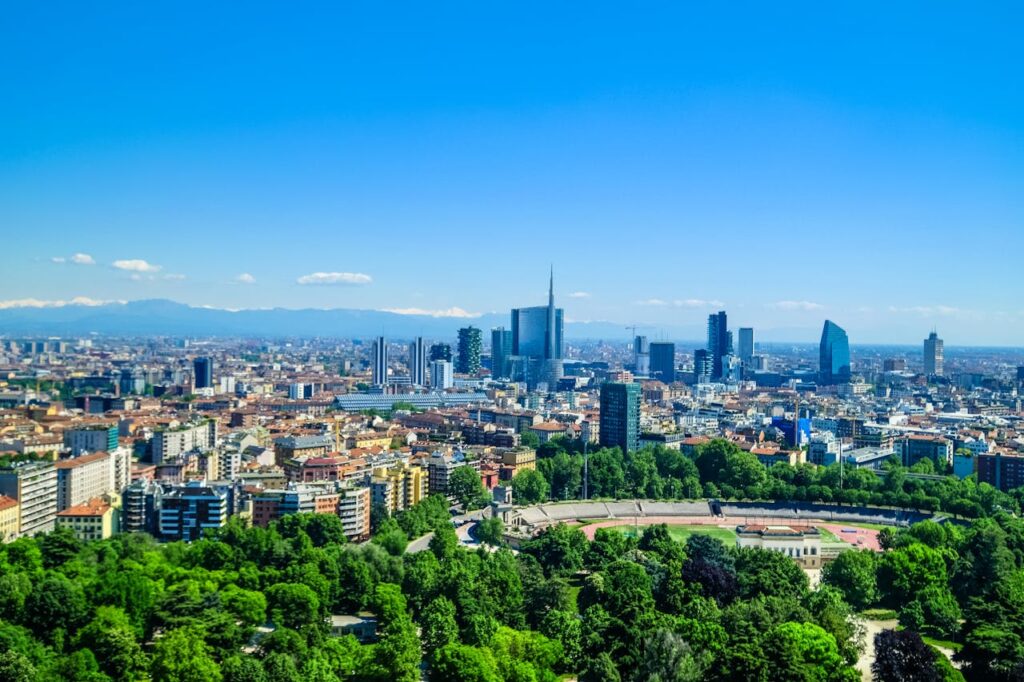
Today, walking along Via Manzoni or sitting at a table in the Galleria, one can still sense something of Hemingway’s gaze. Milan has changed, of course — taller, more cosmopolitan, faster. Yet it retains a hard, solid core he would have recognized.
Perhaps that is why, more than a century later, Milan remains a city for writers: because it tests you, fascinates without fully seducing, and forces you to find your voice. Just as it did for Ernest Hemingway, the young man who became a legend.
Foto di Francesco Ungaro: https://www.pexels.com/it-it/