

JOBY AVIATION: A NEW FORM OF TRANSPORTATION IS ABOUT TO TAKE FLIGHT
For more than a century, ground transportation and aviation have existed as largely separate worlds. eVTOL aircraft promise to bridge that gap — and Joby Aviation is approaching the moment when an experimental technology could become a real transportation service.
For more than a century, aviation has had one seemingly unavoidable characteristic: before you can fly, you first have to reach an airport. Aircraft have transformed distances between cities and continents, but they have done much less to change how we move within metropolitan areas. To travel thirty kilometers across a major city, we still rely essentially on the same surface infrastructure: cars, buses, trains and subways.
Helicopters demonstrated long ago that another possibility exists. They can take off vertically, avoid traffic and directly connect relatively small points within a city. Yet they have never become a form of mass transportation. They are expensive, noisy, mechanically complex and demanding to maintain. For most people, a helicopter remains something they see passing overhead, not something they consider using to get from one part of the city to another.
A new generation of aviation companies is trying to change this through a technology known as eVTOL — electric Vertical Take-Off and Landing aircraft: electric vehicles capable of taking off and landing vertically, flying rapidly like small airplanes and operating at radically lower noise levels than conventional helicopters.
Among the companies attempting to turn this idea into a new form of mobility, one is now particularly close to the decisive transition between experimentation and reality. Its name is Joby Aviation. After more than fifteen years of development, thousands of test flights, a lengthy certification process and the construction of the first dedicated infrastructure, Joby is attempting something that happens very rarely in the history of transportation: introducing an entirely new mode of transport.
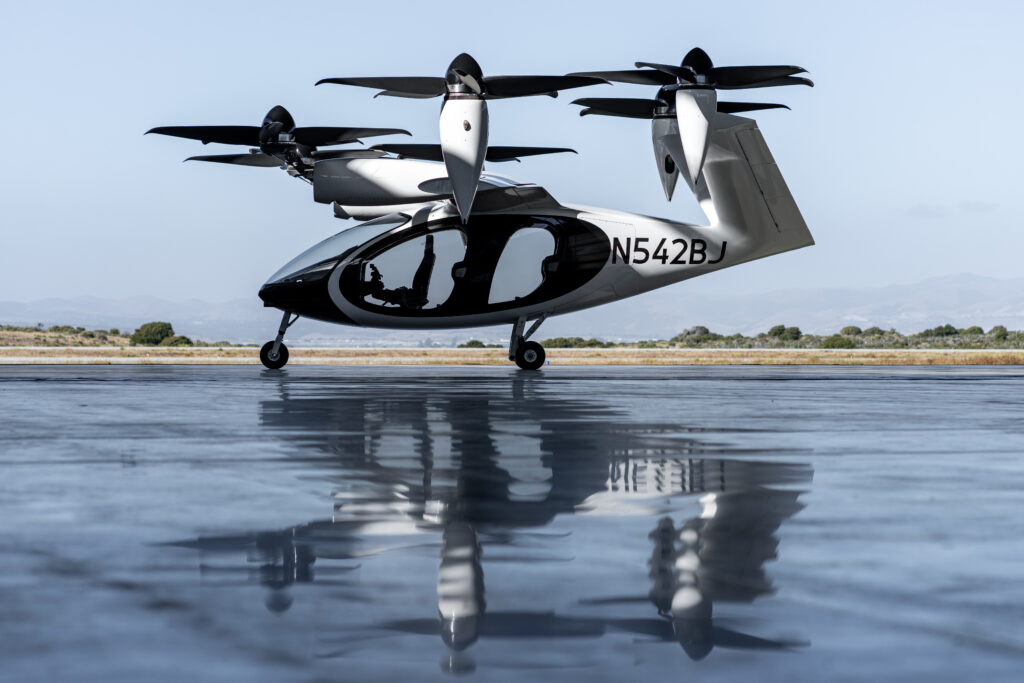
COMPANY PROFILE
Company: Joby Aviation, Inc.
Founded: 2009
Founder and CEO: JoeBen Bevirt
Headquarters: Santa Cruz, California, United States
Industry: Aviation / Advanced Air Mobility
Core business: Development and future operation of eVTOL air transportation services
Core technology: Electric vertical take-off and landing aircraft
Configuration: 1 pilot + 4 passengers
Propulsion: Distributed electric propulsion
Stock exchange: New York Stock Exchange
Ticker: JOBY
Principal industrial locations: California and Ohio
Website: jobyaviation.com
NOT AN ELECTRIC HELICOPTER
To understand Joby, it is first necessary to clear up a misconception. Its aircraft is not simply a helicopter with a different engine. It is a machine designed around the possibilities created by electric propulsion.
The aircraft uses six electric propulsion units distributed across its wings. During take-off and landing, the propellers are positioned to generate the vertical thrust required to lift the aircraft. Once altitude has been gained, they progressively tilt to enable forward flight. The aircraft therefore transitions from behaving like a vertical-lift vehicle to the much more efficient configuration of a wing-supported airplane.
This distinction is fundamental. A helicopter must continuously use its rotor to remain airborne. An eVTOL such as Joby’s instead relies on its wings during the principal phase of flight. The result is an aircraft designed to carry four passengers in addition to the pilot, reach speeds of around 200 mph — approximately 320 kilometers per hour — and offer a maximum range of roughly 100 miles under its intended operating conditions.
But speed and range tell only part of the story. The real innovation may lie elsewhere.
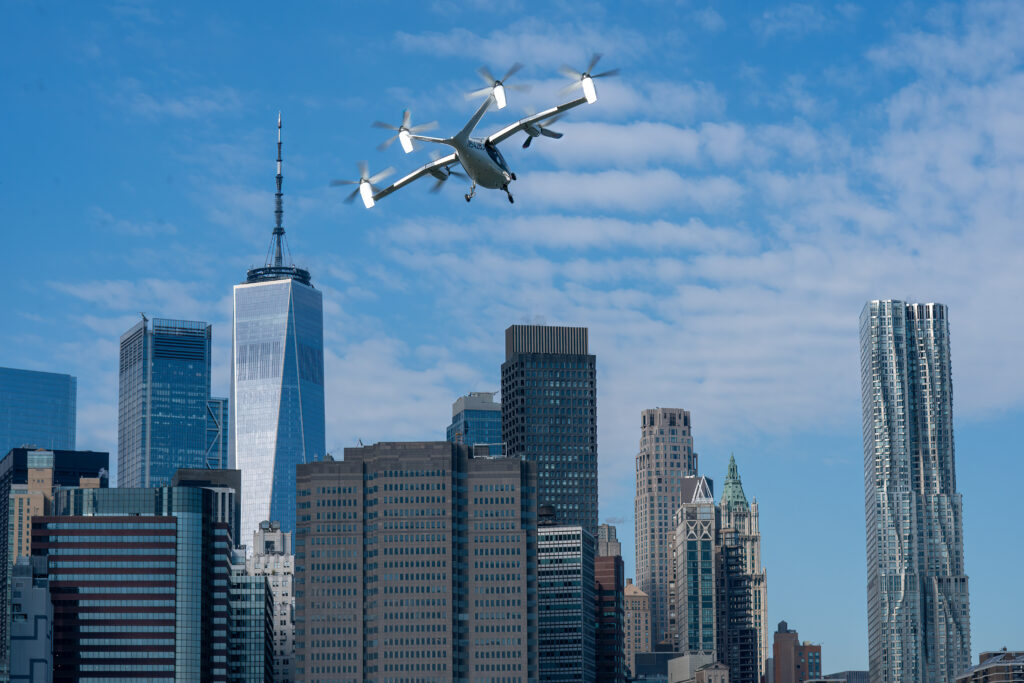
THE NOISE PROBLEM
Helicopters can already perform many of the functions promised by air taxis. Yet they do not fill the skies above our cities. One reason is noise.
The characteristic beating sound of a helicopter results largely from the aerodynamic interaction between its large rotor blades, the surrounding air and the vortices generated by preceding blades. It is intense, impulsive noise that can be perceived from considerable distances. For an urban transportation network, this matters enormously: an occasionally used heliport may be acceptable; hundreds of daily movements above residential neighborhoods would be an entirely different proposition.
Distributed electric propulsion makes it possible to approach the problem differently. Instead of one enormous rotor, Joby uses multiple propellers specifically designed to reduce acoustic impact. During forward flight, the wings support the aircraft and the propulsion units can operate under more favorable conditions.
Noise reduction is therefore not simply a matter of passenger comfort. It is one of the technologies that could determine whether advanced air mobility can exist on a meaningful scale. A new form of transportation must do more than work: it must be capable of coexisting with the cities it intends to serve.
THE REAL PRODUCT IS TIME
Joby’s fundamental promise can be explained without discussing aviation at all. It is about time.
Large cities have developed a paradox: they have become economically more important, denser and more interconnected, while moving across them can take increasingly long periods of time. A relatively modest distance can turn into an hour or more in a car.
eVTOL introduces another possibility: using the third dimension. A winding road journey becomes an almost direct line; congestion disappears beneath the aircraft; rivers, bridges, mountains, suburbs and highway networks cease to determine the entire geometry of the journey.
This does not mean eVTOL will replace cars or railways. It is much more plausible to imagine it as an additional layer within the transportation network. And this is precisely where the idea becomes interesting: Joby is not necessarily trying to sell people a new kind of aircraft. It is trying to sell minutes.
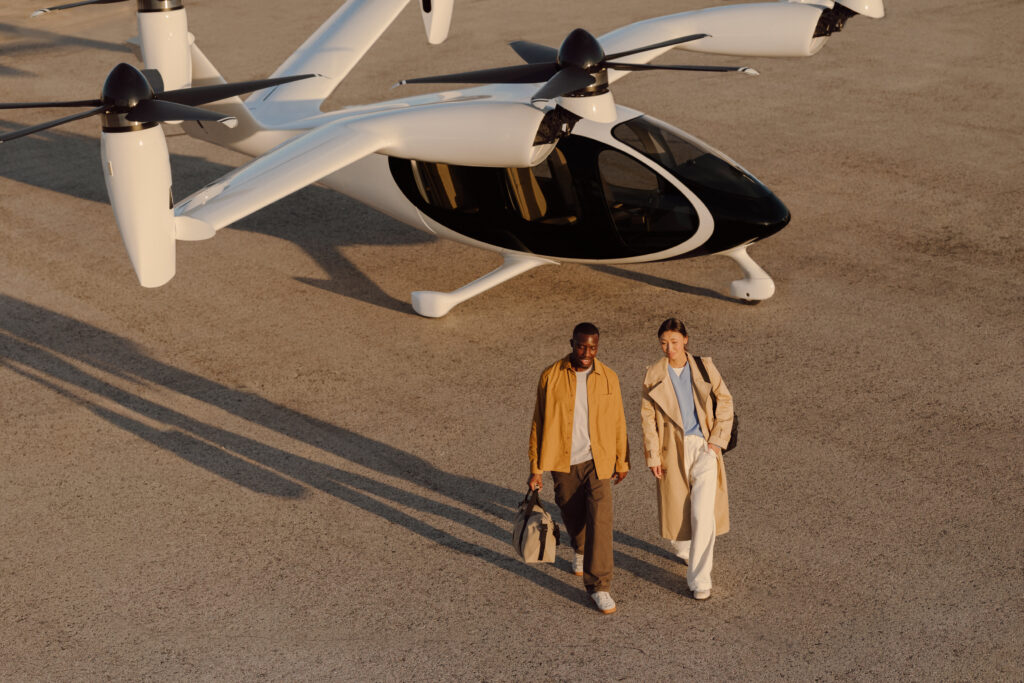
FROM SANTA CRUZ TO A NEW CATEGORY OF AVIATION
Joby was founded in 2009 by JoeBen Bevirt, an entrepreneur and engineer with previous experience in robotics. For years, the project was developed largely away from public attention.
The reason is understandable. Creating a new aircraft is already extraordinarily difficult. Simultaneously creating a new propulsion system, a new aircraft architecture and an entirely new category of transportation service is harder still.
Over the years, Joby has built and tested multiple generations of prototypes, accumulating experience in electric flight, control systems, batteries, motors, acoustics and manufacturing. But the real barrier separating an impressive prototype from a transportation system is not whether it can fly. It is certification.
THE MOST IMPORTANT WORD: CERTIFICATION
Commercial aviation does not work like the software industry. It is not possible to release a beta version of an aircraft and fix the problems later. An aircraft intended to carry passengers must demonstrate to aviation authorities that its design, components, systems, manufacturing processes and performance meet extraordinarily demanding standards.
In the United States, Joby is progressing through the Federal Aviation Administration’s Type Certification process. The company divides this process into five stages. The early stages establish the certification basis, the methods through which compliance will be demonstrated and the testing programs; the later stages involve analysis, testing and ultimately demonstrating to the regulator that the aircraft satisfies the agreed requirements.
As of July 31, 2026, Joby reported that the early stages had been completed and substantial progress had been made through stages four and five, the final stage. The company reported its own work as 83% complete in stage four and 20% complete in stage five; on the FAA side, the corresponding figures were 77% and 10%.
Those percentages alone cannot predict a certification date, but they tell us something important. Joby is no longer merely trying to demonstrate that an eVTOL can fly. It is trying to demonstrate that it can become a certified aircraft for commercial passenger transportation.

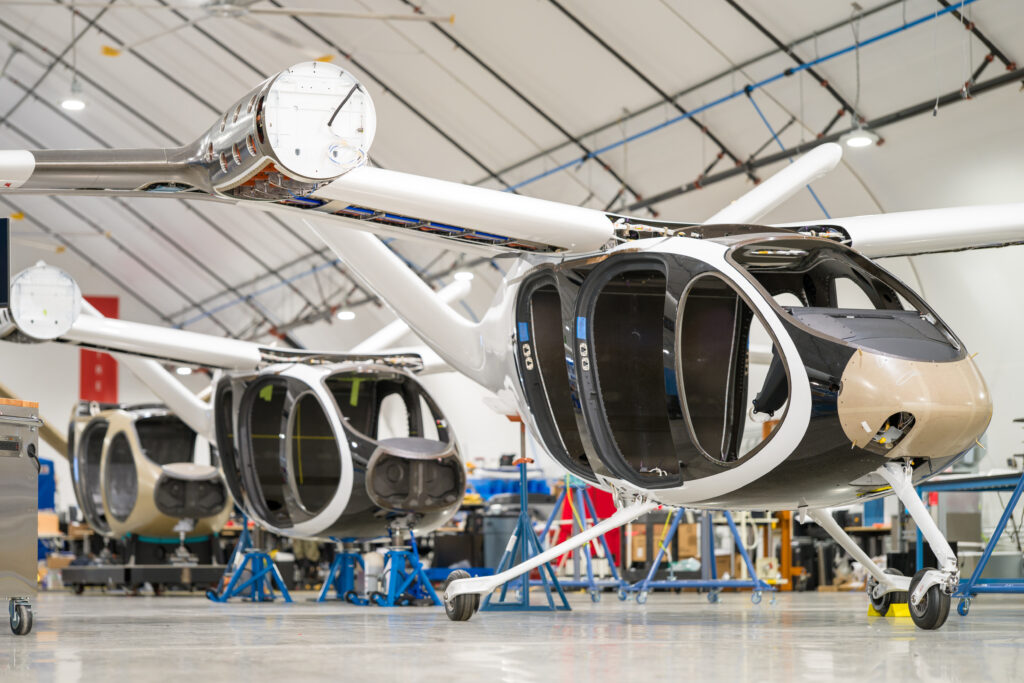
FROM PROTOTYPE TO FACTORY
There is a second transition that may be equally difficult: building one experimental aircraft is one thing; building hundreds of them reliably and repeatedly is another.
By mid-2026, Joby had five aircraft in flight and another twelve in production. At the same time, it has been expanding its industrial presence across California and Ohio and has stated its intention to progressively increase manufacturing capacity.
And this is where an unusual partner for an aviation company enters the story: Toyota.
The collaboration between Joby and Toyota has lasted for more than seven years. Toyota has done more than provide capital: its engineers have worked alongside Joby on manufacturing, quality and design for manufacturability. In June 2026, the two companies took another step by creating a joint venture intended to prepare for large-scale commercial production.
The logic is significant. Aviation knows extremely well how to manufacture sophisticated aircraft in relatively limited numbers. The automotive industry knows something different: how to produce complex machines at scale while maintaining quality, repeatability and cost control. If eVTOL aircraft are ever to become a widespread mode of transportation, these two industrial cultures will somehow have to meet. Joby and Toyota are attempting to build precisely that bridge.
DUBAI AS A LABORATORY FOR THE FUTURE
A new transportation technology also needs somewhere to begin. For Joby, one of the most important places may be Dubai.
The city has several characteristics that make it almost ideal for experimenting with air mobility: a high concentration of premium travel, significant urban distances, modern infrastructure, a major tourism industry and a public administration actively interested in introducing new transportation technologies.
Joby has an agreement with Dubai’s Roads and Transport Authority to develop an air taxi service in the emirate and is working with UAE authorities on the necessary regulatory pathway. In 2026, the vertiport at Dubai International Airport was reported as completed, while a second site at the American University in Dubai was approaching completion.
The word vertiport may eventually become as familiar as station or terminal. It describes a relatively compact infrastructure designed for the take-off, landing, charging and passenger handling of eVTOL aircraft.
If this new form of mobility expands, vertiports could appear at airports, railway stations, business districts and other strategic urban nodes. They do not require runways several kilometers long. And that is precisely what makes it possible to imagine aviation becoming much more deeply integrated into the urban fabric.
THE AIRPORT COULD BECOME MUCH CLOSER
One of the most intuitive early uses for air taxis may be connecting cities with traditional airports.
The problem is universal: a passenger can cross a continent in a few hours and then spend another hour sitting in traffic to travel the final thirty kilometers. eVTOL could change that equation. A passenger could reach an urban vertiport, board a small electric aircraft and arrive directly at the airport within minutes.
It does not replace the airliner. It completes the journey.
In this sense, Joby may not truly be competing with Boeing, Airbus, trains or cars. It could occupy a space that today is served inefficiently by a combination of taxis, private automobiles and, for a tiny minority of passengers, helicopters.
THE ECOSYSTEM MATTERS AS MUCH AS THE AIRCRAFT
For this vision to work, however, building the aircraft is not enough. It requires vertiports, booking systems, pilots, charging infrastructure, maintenance procedures, integration with existing transportation networks and a traffic management system capable of accommodating a new category of aircraft.
Joby is therefore developing something that increasingly resembles not simply an aviation program but a mobility platform. This strategy became even clearer with the acquisition of Blade’s passenger operations and the planned integration of services within the Uber ecosystem.
Blade provides something an aircraft manufacturer would not normally possess: real passengers, real routes, existing infrastructure and operational knowledge of urban air transportation. In the second quarter of 2026, the Blade operations generated $36.2 million in revenue for Joby, contributing to an expected $115–125 million in total company revenue for the year.
The strategic significance, however, extends beyond revenue. Joby can begin building the network before its own eVTOL is fully operational.
AMERICA OPENS A DOOR
In 2026, another potentially important pathway toward early operations emerged in the United States. The eIPP — Electric Vertical Takeoff and Landing Integration Pilot Program — allows eVTOL operations to be tested in collaboration with federal, state and local authorities before full nationwide commercial deployment.
Joby has identified Texas as one of the first locations where it intends to use the program. In September 2026, the company began activities in the Dallas-Fort Worth area aimed at developing routes, procedures and operational experience that could support future services.
The stated objective remains to carry its first passengers in 2026 while the broader FAA certification process continues. This is an important transition because it begins turning a technology into a real operating system. And transportation systems are ultimately learned by operating them.
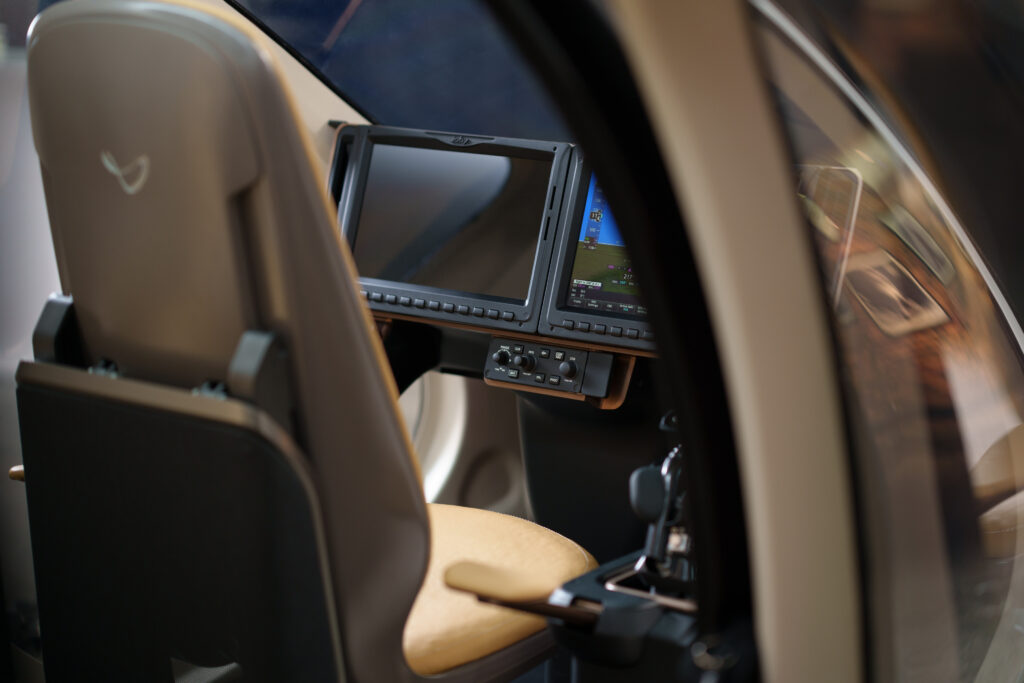
AFTER THE PILOT?
There is another, even more radical transformation that may eventually follow.
On September 18, 2026, Joby announced that an aircraft equipped with its autonomous technology had completed a flight across the United States. It was not the passenger eVTOL but a modified Cessna Caravan used as a platform for developing and demonstrating the company’s autonomous systems.
The aircraft traveled 3,199 miles while autonomously taxiing, taking off, navigating and landing, without control inputs from the safety pilot on board and under remote supervision.
This does not mean pilotless air taxis are imminent. Certifying an autonomous system for passenger transportation represents an entirely different challenge. But it indicates the technological direction.
Initially, eVTOL aircraft will be piloted. In the future, autonomy could once again change the economics of the system, potentially increasing available capacity and freeing an additional seat within the aircraft.
The story could therefore unfold through two successive revolutions: first electrifying vertical flight, and then, potentially, automating it.
THE MILITARY DIMENSION
The technologies developed for an air taxi have applications extending far beyond urban transportation. An aircraft capable of taking off vertically, operating with a reduced acoustic signature and using electric or hybrid propulsion can have applications in logistics, emergency response and defense.
Joby has worked with the U.S. Department of Defense for years and has progressively expanded its activities in the sector. In 2026, the company also announced the acquisition of Resonant Sciences to further strengthen its capabilities in defense and autonomous systems.
It is an important reminder: mobility technologies rarely remain confined to the application for which they were originally conceived. GPS originated in the military. The internet had government and academic origins. Jet engines transformed military aviation before reshaping civilian flight. Distributed electric propulsion and autonomous aviation could follow similarly broad paths.
THE DECISIVE QUESTION: HOW MUCH WILL IT COST?
Every transportation revolution eventually encounters the same question: how much will it cost?
An electric air taxi can be technologically remarkable, quiet and fast. But if the service remains accessible only to a tiny segment of users, it will not become a new mode of transportation in the broader meaning of the term.
Early operations will inevitably be limited. That is what normally happens with new technologies: the first commercial airline journeys were expensive, early automobiles were products for the few, and the first mobile phones were enormous and extremely costly devices.
The significant question, therefore, is not simply the initial price. It is the cost curve.
Electric propulsion eliminates numerous mechanical components associated with combustion engines and conventional transmissions. Electric motors can contain relatively few moving parts. Over time, maintenance could therefore look very different from that of conventional helicopters. Added to this is the potential effect of the volume manufacturing Joby and Toyota are attempting to achieve.
If these factors can progressively reduce the cost per passenger, the air taxi could move from a premium service toward a broader transportation category. This may be one of the most important transitions in the entire story.
WHAT COULD CHALLENGE THIS SCENARIO?
The vision is compelling. Making it real will be extraordinarily difficult.
The first obstacle remains certification. Joby has made substantial progress, but certifying a new aircraft and a new architecture takes time. Delays are possible and, in aviation, regulatory caution is a necessary feature rather than a flaw.
The second challenge is manufacturing. Moving from a handful of aircraft built with extraordinary care to reliable industrial production represents one of the hardest transitions for any aviation company.
The third is batteries. Aviation is exceptionally sensitive to weight. Battery performance has improved enormously, but energy density remains far below that of aviation fuels. eVTOL aircraft therefore have a specific operating envelope and will not replace conventional airplanes over long distances.
The fourth is infrastructure. An aircraft may take off vertically, but it still needs authorized places from which to operate, electricity, charging systems and integration with the city.
The fifth is public acceptance. Perceived safety, noise, visual impact and the willingness of communities to accept increasing numbers of aircraft above urban areas will all matter.
The sixth is cost. The system must demonstrate not merely that it can operate, but that it can achieve sufficiently favorable economics to create meaningful demand.
And finally, there is competition. Joby is not alone. Numerous companies around the world are developing eVTOL aircraft using different architectures. Some will inevitably disappear; others may develop better solutions for particular markets. As in the early years of automobiles and aviation, it is too soon to know what the eventual industrial structure will look like.
IT DOES NOT HAVE TO REPLACE THE CAR
Perhaps one of the most common mistakes when evaluating a new transportation technology is immediately asking which previous mode of transport it will replace.
The automobile did not eliminate the train. The airplane did not eliminate the automobile. The subway did not eliminate the bus. Each technology occupied the spaces in which it offered a particular advantage.
For eVTOL aircraft, that space may consist of distances too long or congested to travel quickly by car but too short to justify conventional aviation: twenty kilometers across a city, an airport far from downtown, two communities separated by a bay, a connection across mountainous terrain, an urban journey requiring ninety minutes by road but only ten or fifteen minutes in a straight line.
These are the spaces where the third dimension can have value.
WHEN A TECHNOLOGY BECOMES TRANSPORTATION
The history of mobility is full of extraordinary inventions that never became transportation systems. Inventing the machine is not enough. Everything around it must also be created.
Cars needed roads, fuel stations, repair shops, parking, insurance and traffic rules. Commercial aviation needed airports, air traffic control, maintenance, training, certification and reservation networks. eVTOL aircraft will need their own ecosystem.
And this is precisely what makes the present moment interesting. Joby is no longer working exclusively on the aircraft: it is working on manufacturing with Toyota, vertiports in Dubai, routes in the United States, passenger integration through Blade and Uber, FAA certification, autonomy, training and operations.
In other words, it is beginning to build the system around the machine.
That is the transition that separates an invention from a mode of transportation.
THE SKY ABOVE OUR CITIES
It is impossible to know today how common this form of mobility will eventually become. Perhaps air taxis will remain concentrated on airport routes and premium connections. Perhaps they will become a relatively common component of major metropolitan transportation networks. Perhaps some cities will adopt them rapidly while others restrict them. And the technology itself will probably change many times.
But one thing is becoming increasingly concrete. The idea of traveling above a city aboard a small electric aircraft no longer belongs exclusively to science fiction.
The aircraft exist and they fly. Factories are increasing production. Vertiports are being built. Regulators are developing the rules. The first operational networks are beginning to take shape. And certification systems are progressively transforming experimental machines into potential commercial aircraft.
For more than a century, we have looked at the sky above our cities primarily as the space crossed by airplanes traveling somewhere else. Joby imagines something different: that this space could become part of the city itself. A new road that does not need to be paved, a network that does not pass through intersections, a form of mobility that uses a dimension which, until now, has remained almost entirely unused by everyday transportation.
We do not yet know how large it will become. But after fifteen years of development, the question surrounding eVTOL aircraft is slowly changing.
It is no longer simply: can they work?
It is becoming: what happens when we actually start using them?
EDITORIAL NOTE
CulturesMag covers companies, technologies and industrial transformations for editorial and informational purposes. This article concerns the company, its products, technology and industry and does not constitute investment advice or a recommendation to buy, sell or hold any financial instrument.